‘If your pics aren’t close enough
they’re not good enough’If one reads this quote having the personal history of Robert Capa in mind, meaning and implications seems quite straightforward: you need to be where the action is, you need to be physically close, and you will get a good picture.
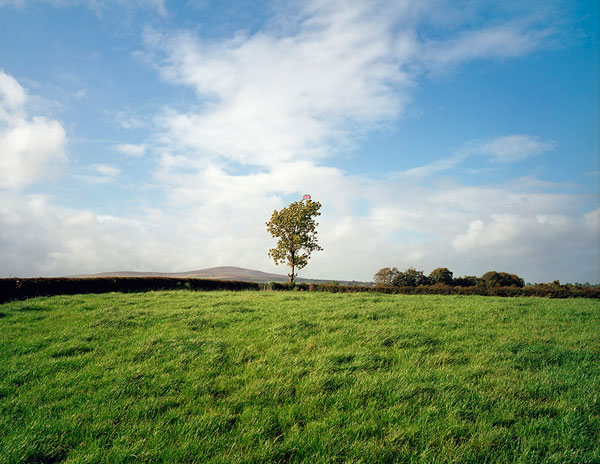
So, the first obvious approach is to challenge this dictum by investigating the relationship of “close physical proximity” and “good pictures”. The pictures of Paul Graham - broad landscapes, near absence of action, where only small, far away details suggest the presence of conflict - could be used to contrast this view: a distant viewpoint can also reveal a lot about conflict and lead to good pictures. But this essay will not focus on this angle only. The point of departure of this essay is to accept that by milling on this quote, further questions are unavoidable. What constitutes a “good” war picture? What does “close” really mean? Close to whom, close to what? In a time of changing warfare, where is the battleground, anyway, and where is war felt?
This essay will not focus so much on replying to these questions. It rather argues the importance to ask them. The very act of asking can result – as this essay will show - in different approaches to war photography, different viewpoints and aesthetics. All of these are very relevant in trying to capture the complexity of warfare and its ripple effects at the present day.
 “good” = “close”?
A war picture - being originated in a context that is so loaded with meaning and ethical dilemmas - cannot be judged based on its aesthetic only. Actually the very debate on the legitimacy of aesteticizing suffering and conflict has been an underlying question for many years, and a fil-rouge in the influential criticism of Sontag [Sontag 1977, 2003]
Whatever the positioning on that debate, it is probably safe to say that judgement on the quality of “good” war photography transcends the mere aesthetics, and need to consider its value as testimony.
Testimony is related to the concept of proximity and closeness: it is about being there, physically. It is about being in a place where most people would not want to be, and to witness.
The value of this closeness is demonstrated, in the competitive photographic market, by the premium attached to it, which - however - also came bundled with risk. “It is left to the people on the ground to decide what is worth the risk and what is not. I leave it to your imagination what t happens is you say to your boss than an assignment is too risky, and your competitor gets the picture (Mathias Eick, war correspondent, quoted in Moeller, 1999: 19)
But - as demonstrated by Graham - there is a value in breaking this unwritten rule of the primacy of closeness: understanding war sometimes requires a broader perspective, and distance. Stepping back to look at the context, or at the details at the margin of action, can actually give new perspectives to war.
Norfolk raised the bar even further by distancing himself also in time, when taking pictures in the land of forgotten conflicts, such as Armenia or Namibia. Again, distance adds meaning: “What these photographs tell us is that even infamy is subject to entropic decay. Even large and terrible crimes are eventually forgotten […]. This is hard to bear. We do no want to live in a world where crime escapes punishment […] [Ignatieff in Norfolk 1998: no page]
 How close a photographer will want to be?
There are questions about the legitimacy of being so close to suffering and portraying it, and different photographers will have a different take to it. This is where physical closeness and emotional closeness start to interplay. There is the gung-ho, adrenaline pumping desire of proximity of the stereotype war photographer, but there are also forms of proximity that are declaredly accompanied by detachment, or by the deep desire to be elsewhere. So, physical proximity interplays in different ways with the emotions and the standing of the photographer. This has certainly a role in the way a picture is composed, and in its purpose. Nachtwey affirmed “Every minute I was there, I wanted to flee. I did not want to see this” [WarPhotographer 2001. He then grounded his decision to stay in the value of testimony.
Linked to any judgement of the opportunity of closeness there is then the decision as to where to position oneself in a war. Close to whom? Taking sides (like Capa in the Spanish war or Griffith in Vietnam)? Attempting to be neutral and see the different facets of conflict? Or simply occupying whatever space is on offer, as it is increasingly happening to “embedded journalists”?
At a time of changing warfare, access as been a casualty and even neutral actors such as journalists or humanitarian workers now find it next to impossible to operate. The very fact of reclaiming a choice of physical proximity becomes a valiant act. “We chose to work unembedded so that we might provide another perspective on this war. And I mean that literally: we sought out a specific physical perspective — not a specific political perspective — outside the American bases and armoured vehicles” [Thorne Anderson in: Komp 2006]
 Close to whom? People… emotions…
 It would not give justice to Capa to affirm that, for him, closeness was only about physical closeness to action and battle. His pictures of the Spanish Civil war do clearly convey that he was taking sides, that he had empathy, that the people in the pictures and their life really mattered for him.
When it comes to emotional closeness, there are different perspectives: Delahaye affirmed that he can only restore the suffering through detachment [Sullivan 2003] and then caused a stir by emphasizing the aesthetic qualities of his picture of dead Taleban, transformed into art gallery work.
Pellegrin also attempts to operate at a level beyond the “documentary” only, but he does so to bring in, strongly, emotions. Whilst the memorable pictures of Capa of the D-Day where “slightly out of focus” for technical issues, the pictures of Pellegrin are explicitly built in conditions of marginal light, they are blurred to give a sense of not finished which shall lure the viewer closer to them
 How close can a viewer be?
If ethics are considered in determining was a good war photograph is, then many would agree that a good picture should bring the viewers close to the war and the suffering, overcoming their “compassion fatigue” [Moeller 1999]. Nachtwey, as many others, had argued that a powerful picture should put people in touch with war, should help people to see what the war does. A picture should “protest, and by the strength of that protest to make others protest” [Natchway 1985]. So, the idea of closeness can be stretched to apply, somehow, also to the viewer.
But there are critics of this attempts to bring suffering close to the people. Sontag affirms that “no one has the right to experience the suffering of others at a distance” [Sontag 2003: 105]. And she makes clear that even good intentions can be defeated as “in a world in which photography is brilliantly at the service of consumerist manipulations, no effect of a photograph of a doleful scene can be taken for granted [ibidem: 71]
 Insiders: too close for comfort?
An outsider can see - maybe feel - but never really experience war as these forcefully involved in it do. However close, ultimately s/he will deploy his superior power and stance when capturing an image.
Nowadays images of war are increasingly captured not only by professional outsiders, but also by insiders: those who plan the war, those who fight it, those who experience it. This had happened in the past, but the widespread availability of cameras and channels or dissemination is giving a new dimension to the perspective of insiders. Their (often forced) closeness constitutes a unique view point. The identity of the insider (his/her role, loyalties, power…) will define to a large extent what it is possible - or not possible - to convey. It will also model the meaning that viewers will attribute to these pictures.
The pictures of Ziyah Gafic, for example, tell us about the life of people during the Bosnia war. Insider’s closeness is a fundamental ingredient in creating the intimacy of its work: often the people portrayed are his own relatives and acquaintances.
At the other side of the spectrum there are the pictures taken by the combatants, which sometimes trickle out on web and media. Rather than the anesthetized views of the battle proposed by official war photography, they display the extremely personal and crude perceptions of war as seen by he troops. The site (now closed) www.nowthatsfuckedup.com - which offered porn pictures to the troops in Iraq in exchange for their own picture of combat - was an extraordinary testimony, maybe too close for comfort. The same crude and cruel power deployed by the troops in combat also spilled over into their photography. How would ethical concerns play when judging such photography, if they were beautiful? Could they ever be”good” when they represent hatred and “fucked up” perceptions?
In this case, however, the close-ups of disembodied people, the loveless porn scenes in the barracks were definitely not good pictures. Ricuperati [2006] points out that they lacked a punctum as well as the studium. They lacked intimacy; they portrayed closeness without empathy, anesthetized feelings. He notices that single images have no real visual power per se: they portrait death as ordinary and even boring. It is the sequencing of such pictures, together with the comments of authors and readers, which build up a horrendous picture of war, deprived, as they are, of a “moral justification” and being too close to death and alienation.
 Where is the battleground, anyway?
What is the theatre of war photography? Is it the battleground? And where is the battleground, anyway? Starting with the first aerial bombings, and increasingly now, war action can happen in a place and then hit people far away. Norfolk had shown this efficiently by photographing the computer mainframes in military complexes. If a computer can be the battleground, clearly the idea of proximity, in current warfare, will need to be revised.
When searching for closeness, is the battlefield really the centrepoint? Most people “die from war rather than in battle”. It is the civilian population that pays the price of war [Slim 2008:91]. Casualties are found in peripheral areas. People are hit by straying missiles. People flee their land. People lose their support nets. People die of poverty, of famine, of illness ultimately derived from conflicts and war. So, being really close to these affected by war might mean to stir away from the glamorous centre of action, or stay behind when the media circus leave a place.
The “battles” happening in such places are often battles for survival, an attempt to put together the resemblance of normal life. Being close and responsive to these situations might mean to refuse, as Salgado, to portrait people as victims without dignity [Levi Strauss 2007]. It can also mean to capture glimpses of their happiness and “normal life”, reclaimed against all odds – as Lowe in Bosnia.
Conclusions“If your pictures aren’t close enough they’re not good enough’ proved to be a sentence that could be read in many different ways. Playing with its meaning, this essay argued that different interpretations of closeness and of the concept of “location” of war can lead to many different, somewhat contrasting, perspectives on war photography.
In addition, closeness should not only be judged by the positioning of the photographer. The sense of closeness created in the viewer is equally important in judging the merit of a war photography.
I would discard the idea than only close proximity to action achieves good pictures. I rather believe that it is only by cumulating different angles and interpretations of “closeness” than war and changing warfare can be represented, and that their effects can be brought close to distant - and often too detached - viewers.
ReferencesBLDGBLOG (2006), “War/Photography: An Interview with Simon Norfolk” in
BLDGBLOG,
http://bldgblog.blogspot.com/2006/11/warphotography-interview-with-simon.html. Accessed 09/07/08.
Bonaventura, P. (2003). “Paul Graham: The troubles” in:
CIRCA Online. Available at:
http://www.recirca.com/articles/paulgraham.shtml. Accessed 09/07/08.
Komp, C, (2006). “Witness to war. Unembedded photojournalism in Iraq” in
Clamor. Available at:
http://clamormagazine.org/issues/36/media.php. Accessed 09/07/08.
Levi Strauss (2007).
Politica della fotografia. Postmedia, Milano.
Lowe, P. (2005).
Bosnians. Saqi books, London.
Magnum website (no date). Paolo Pellegrin Portfolio on Magnum Site. Quote available at
http://www.magnumphotos.com/Archive/C.aspx?VP=XSpecific_MAG.PhotographerDetail_VPage&l1=0&pid=2K7O3R13CHLN&nm=Paolo%20Pellegrin. Accessed 09/07/08.
Moeller, S.D (1999).
Compassion Fatigue. Routledge, New York and London.
Nachtwey, J (1985).
Why Photograph War?. Available at:
http://www.war-photographer.com/en/wp_Pressbook_E.pdf. Accessed 09/07/08
Norfolk, S (1998).
For most of it I have no words. Dewi Lewis Publishing, Stockport.
Pellegrin, P (2007). Video-interview available at:
http://dailymotion.alice.it/Theblogtvcityzen/video/x24xqx_intervista-al-fotoreporter-paolo-pe. Accessed 09/07/08. (translation from Italian by the author)
Ricuperati (2006).
Fucked up. BUR, Milano
War Photographer (2001) . Directed by Christian Frei. Switzerland. Christian Frei Filmproductions.
Slim, H (2008).
Killing Civilians: Method, Madness, and Morality in War. Columbia Univ. Press, New York.
Sontag, S. (1977).
On Photography. Penguin, London. Reprint Penguin Classics 2002.
Sontag, S. (2003).
Regarding the Pain of Others. Pengiun, London.
Sullivan, B. (2003). “The real thing: Photograper Luc Delahaye” in:
Artnet. Available at:
http://www.artnet.com/magazine/features/sullivan/sullivan4-10-03.asp. Accessed 09/07/08.
List of Pictures1: Robert Capa – Ohama beach – 6 June 1944
Whelan, R (2001). Robert Capa. La Collezione Completa. Phaidon, London.
2: Paul Graham – Union Jack flag in tree, County Tyrone, 1985
Graham, P (no date). “Troubled land” in Paul Graham Archive. Available at:
http://www.paulgrahamarchive.com/images/troubledland/TL-01.jpg. Accessed 09/07/08.
3: Luc Delahaye – Dead Taleban
Sullivan, B. (2003). “The real thing: Photographer Luc Delahaye” in: Artnet. Available at:
http://www.artnet.com/magazine/features/sullivan/sullivan4-10-03.asp. Accessed 09/07/08.
4: Paolo Pellegrin. Civilians fleeing Basra dusing US-led invasion.
Pellegrin, P (2007). As I was dying. Dewi Lewis Publishing, Stockport. p 12.
5. James Nachtwey. Bosnia, 1993 - Wounded soldier.
Nachtwey, J. (1999). Inferno. Phaidon, New York. Reprinted 2006. p 200.
6: A picture from the website www.nowthatsfuckedup.com
Ricuperati (2006). Fucked up. BUR, Milano. P. 100.
7: Simon Norfolk (no date), “Modelling Physics inside and exploding nuclear warhead.
Norfolk, S (no date). “The supercomputers: ‘I am sorry Dave, I am afraid I cannot do that’” in :Et in Arcadia Ego”. Available at:
http://www.simonnorfolk.com/ Accessed 09/07/08